

In the News
National Science Foundation Awards Purdue $300,000 to Expand AI and Microelectronics Education Through Teacher Fellowship
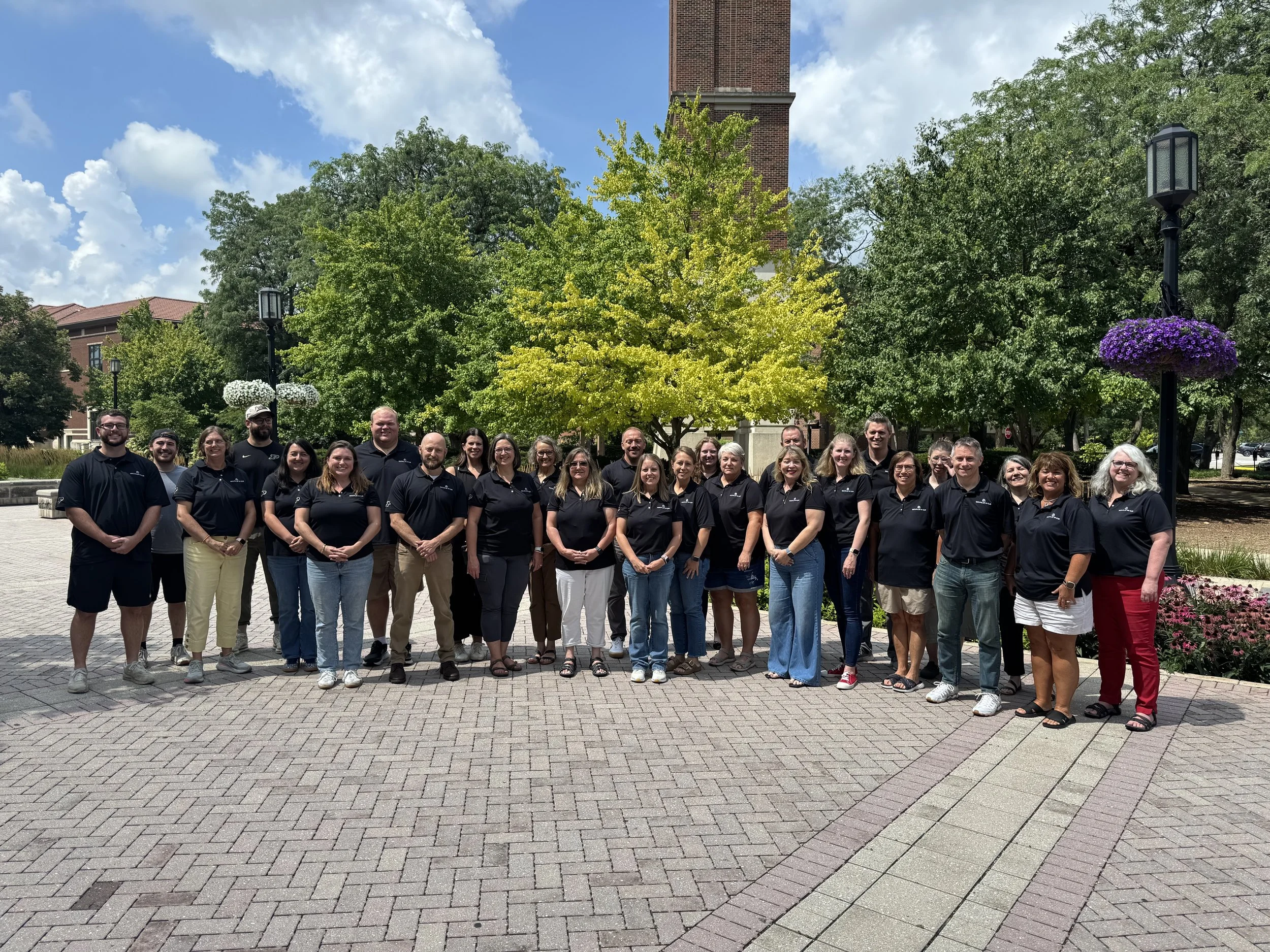
Purdue University’s Noyce Microelectronics Master Teacher Fellowship Program has received a $300,000 supplemental award from the National Science Foundation to expand its work preparing K-12 educators to integrate artificial intelligence education with microelectronics.
The existing NSF-funded fellowship develops a cohort of 18 STEM teachers from high-need schools as leaders in microelectronics education. Fellows participate in summer institutes, ongoing professional development, graduate coursework and district leadership projects focused on creating vertically aligned microelectronics learning and career pathways across K-12 education.
The new funding will strengthen the program’s focus on the growing connection between microelectronics and AI, helping educators explore how intelligent systems depend on semiconductor hardware, data, computing architecture and system design. The expansion will emphasize teacher professional development while also supporting the development of new curriculum and instructional resources.
Beginning in the second year of the fellowship, fellows will participate in a dedicated Microelectronics-AI Summer Integration Institute in partnership with NSF-funded Anvil and SCALE K-12. Through hands-on learning, educators will explore how sensor data, algorithms, hardware design and computational constraints influence AI systems and model behavior.
Fellows will then work alongside SCALE K-12 teachers and Purdue project staff to develop classroom-ready instructional materials that connect AI concepts with the microelectronics systems that make those technologies possible. The interdisciplinary materials will address concepts such as data representation, algorithmic decision-making, model reliability and the relationship between hardware performance and AI outputs.
The supplemental funding will also expand the fellows’ roles as instructional leaders within their schools and districts. Fellows will identify opportunities to incorporate AI concepts into existing K-12 microelectronics pathways and develop professional learning experiences to help other educators understand the connections between microelectronics and AI and integrate those concepts into classroom instruction.
The goal is to build a sustainable network of teacher leaders who can expand access to high-quality AI and microelectronics education, particularly in high-need schools. Curriculum and professional development resources developed through the project will be made openly available through nanoHUB and ChipsHub, extending the work beyond participating schools and allowing educators across the country to adopt and adapt the materials.
“Artificial intelligence and microelectronics are deeply connected, and helping students understand that relationship is increasingly important as we prepare them for the technologies and careers of the future,” said Tamara Moore, co-principal investigator of the Noyce Microelectronics Master Teacher Fellowship Program, director of SCALE K-12 and Purdue’s Crowley Family Professor in Engineering Education. “By investing in teachers as leaders, we can build the knowledge and capacity within schools to create meaningful learning experiences that help students understand how AI works, what makes it possible and the role they can play in the future of these rapidly evolving fields.”
The Noyce Microelectronics Master Teacher Fellowship Program is led by Purdue faculty Greg Strimel, principal investigator, and co-principal investigators S. Selcen Guzey, Tamara Moore and Morgan Hynes. The program operates within the SCALE K-12 network and collaborates with local school districts, Naval Surface Warfare Center Crane Division, the Silicon Crossroads Microelectronics Commons Hub and nanoHUB/ChipsHub.
We acknowledge support from the U.S. Department of Defense [Contract No. W52P1J-22-9-3009], Indiana Economic Development Corporation [Contract No. A281-3-IPF-1028 424208], Applied Research Institute [Contract No. SA-22036.001], and the National Science Foundation [Grant No. 2448266]. Any opinions, findings and conclusions or recommendations expressed in this material are those of the author(s) and do not necessarily reflect the views of the National Science Foundation or any of our other funders.
Purdue Engineering names four winners of faculty Thinky Competition focused on AI
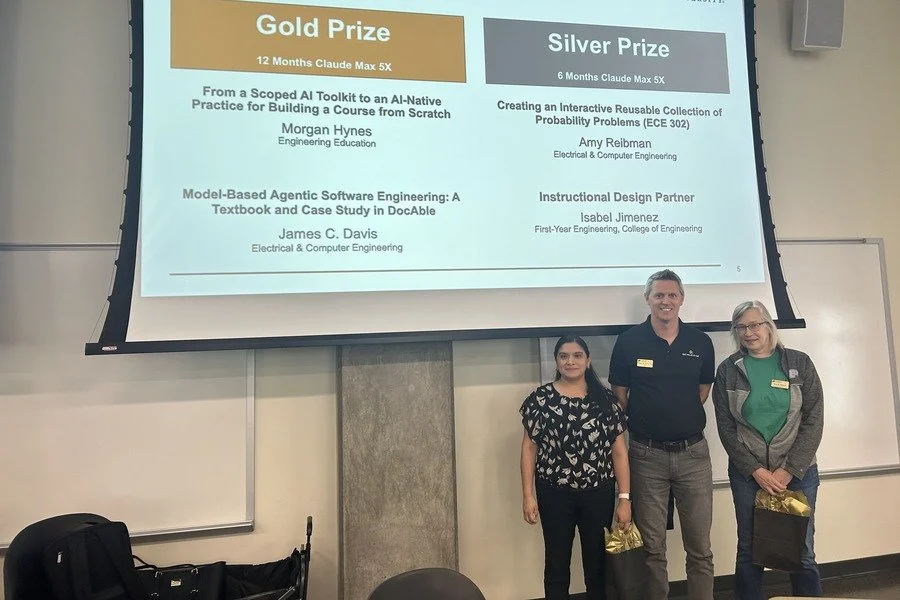
(From left to right) Isabel Jimenez, Morgan Hynes and Amy Reibman (not pictured: James Davis) are recognized during the 2026 Thinky Competition awards announcement at the Aug. 17 ThinkAI Teaching Fair, where the college named four faculty winners for AI-integrated teaching projects. (Submitted photo)
WEST LAFAYETTE, Ind. — This summer, Purdue Engineering faculty created innovative web apps, AI skills, and agents in support of teaching and learning, combining their strong technical domain knowledge with critical human judgment. These creative outputs are part of the Thinky Competition, which was initiated and organized by Stanley Chan, director of Engineering AI Education in the College of Engineering and a professor in the Elmore Family School of Electrical and Computer Engineering (ECE).
As part of the competition, Purdue Engineering named four faculty members as winners during the ThinkAI Teaching Fair on Aug. 17. The competition named two gold prize winners, Morgan Hynes and James Davis, and two silver prize winners, Isabel Jimenez and Amy Reibman.
Hynes, an associate professor in the School of Engineering Education (ENE) and the Multidisciplinary Engineering program, won for "From a Scoped AI Toolkit to an AI-Native Practice for Building a Course from Scratch." According to the full abstract, Hynes used Claude over the summer to build an AI-workflow toolset for IDE 495, a new course teaching students to prototype physical, sensing and interactive experiences. That toolset grew into a full course design: a 15-week, six-project curriculum, six public workflow guides now live at facelab-air.org and a field test with high-school students through the MicroArtistry summer short-term course. The work led to the development of two research papers on designing a course in close collaboration with an AI partner.
Davis, an assistant professor of ECE, won for "Model-Based Agentic Software Engineering: A Textbook and Case Study in DocAble." The abstract describes a "two-birds, one-stone" project: software engineering has been transformed by AI coding agents without a corresponding methodology or textbook, and new ADA accessibility requirements make remediating course materials prohibitively labor-intensive. Davis addressed both by using development of DocAble, an automated accessibility remediation system, as a laboratory to derive model-based agentic software engineering, a methodology for building trustworthy software with AI agents, producing both a deployed web application and a textbook articulating the method.
Jimenez, assistant director of first-year engineering, won for the "Instructional Design Partner," an open-source AI skill that helps faculty create active-learning materials through a structured co-design process, guiding instructors through alignment, scaffolding, artifact creation and validation while keeping faculty in control of final decisions. It's designed for use across ChatGPT, Claude and Gemini.
Reibman, the Elmore Professor of Electrical and Computer Engineering, won for "Creating an Interactive Reusable Collection of Probability Problems (ECE 302)." According to the abstract, the project creates a toolset to rapidly build problem sets for a course without AI intervention: Python scripts split files and generate output in LaTeX and HTML, letting instructors navigate a problem taxonomy and assemble custom sets.
The competition is part of a larger effort the college calls ThinkAI, which also included a May bootcamp on job interviewing in the AI era and a summer workshop series drawing roughly 400 total attendance and 200+ unique attendees, including recognition of 70 Thinky Faculty Fellows.
David Inouye, an assistant professor in ECE, served as the competition's evaluation lead.
"The Thinky Competition was an incredible showcase of how Purdue College of Engineering faculty are exploring AI in teaching," Inouye said. "From automated ADA compliance to full course design, this summer challenge revealed that we are all still learning; AI has surprising strengths and weaknesses. We found that success requires two ingredients: the deep domain expertise our world-class faculty already possess, and explicit control over AI, a skill we are actively learning. By deliberately structuring AI tasks around clear goals, effective workflows, and individual teaching styles, outcomes improve significantly. Ultimately, our driving question remains: how do we most effectively teach our students in the age of AI?"
Senay Purzer, a dean’s faculty fellow and professor of ENE, led faculty upskilling workshops over the summer.
“The Thinky Competition provided a glimpse into the future of education,” Purzer said. “Purdue faculty are leading the way with exemplars integrating human judgement, faculty expertise and AI.”
SCALE K-12 Workshop Equips Indiana Educators to Grow Semiconductor Workforce
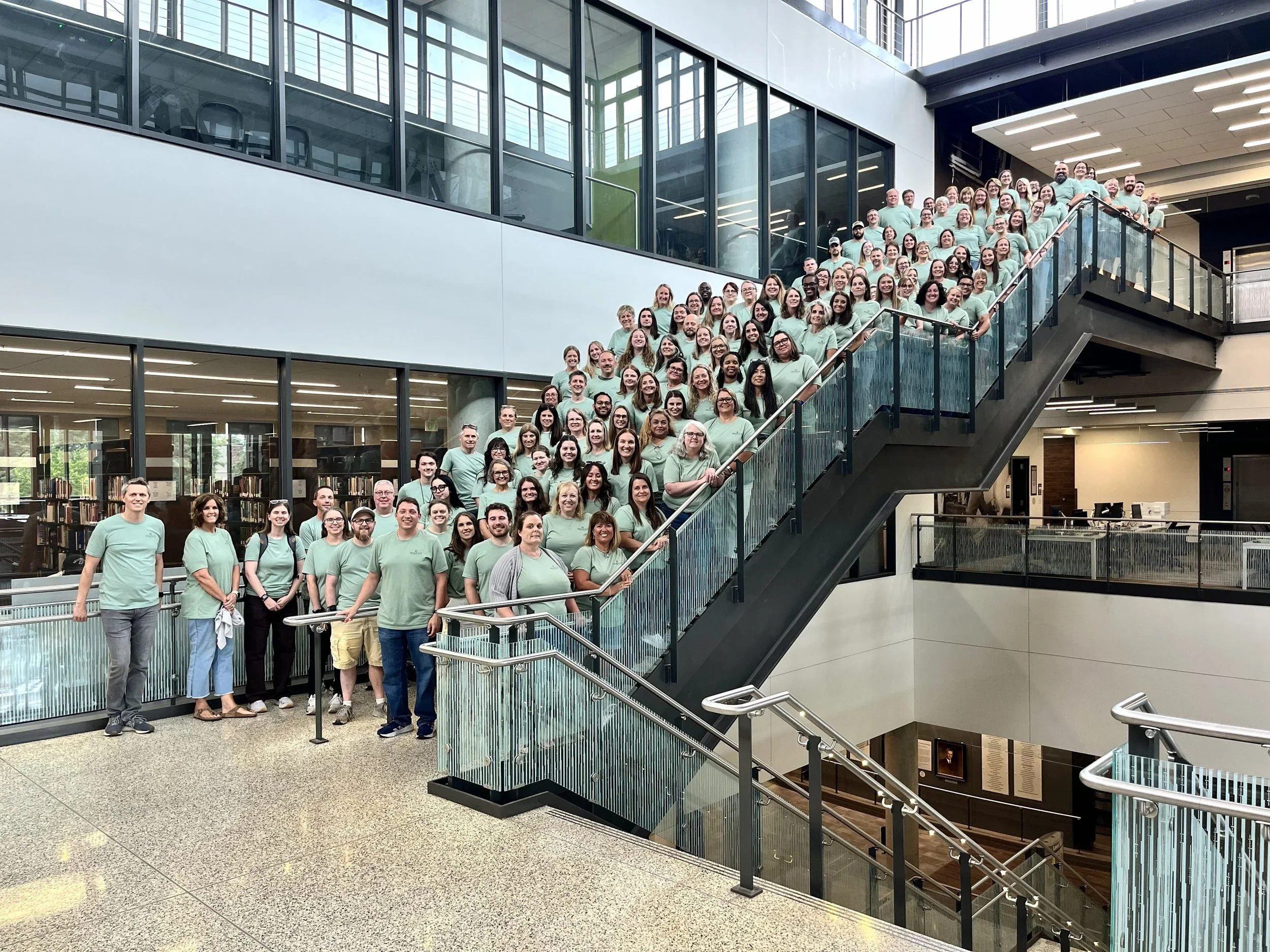
More than 100 Indiana educators gathered in West Lafayette from July 6-10 for Purdue University's SCALE K-12 Educator Workshop, bringing together teachers, university experts and National Science Foundation-funded fellows.
SCALE K-12 — which stands for Semiconductor Connections, Alignment, Learning and Engagement — is a Purdue-led national initiative that connects educators, researchers and industry partners to strengthen the semiconductor workforce pipeline through K-12 education. The program integrates microelectronics concepts into classrooms across grades and disciplines, allowing students to explore semiconductor technologies through hands-on, engaging learning experiences.
Educators selected one of nine interdisciplinary units designed to integrate microelectronics concepts aligned to state standards into existing classroom instruction. Each teacher received a complete instructional unit, materials needed for implementation, and guidance from Purdue faculty and graduate students on instructional best practices.
Educators also toured Purdue’s Birck Nanotechnology Center; explored semiconductor career pathways; learned about the intersection of microelectronics, artificial intelligence and automation; and gained hands-on experience using CNC router technology.
The workshop also provided advanced professional learning opportunities for 18 Noyce Microelectronics Master Teacher Fellows funded through the National Science Foundation. After participating in the workshop, the fellows engaged in specialized sessions focused on instructional leadership, curriculum implementation and strategies for expanding microelectronics education within their schools and districts. The fellows will return to their communities prepared to mentor colleagues, support implementation efforts and help multiply the impact of microelectronics education.
SCALE K-12 has reached more than 30,000 students in 67 schools across 25 districts in Indiana, Illinois, Michigan and California.
“The strength of SCALE K-12 is that we are not only developing curriculum, we are building a community of educators who can inspire students and create lasting pathways into microelectronics careers,” said Tamara Moore, director of SCALE K-12 and Purdue’s Crowley Family Professor in Engineering Education. “By equipping teachers with knowledge, resources and hands-on experiences, we are expanding access to semiconductor education and helping prepare the workforce our nation needs.”
SCALE K-12 Brings Microelectronics Learning to Nation’s Largest Scouting Event
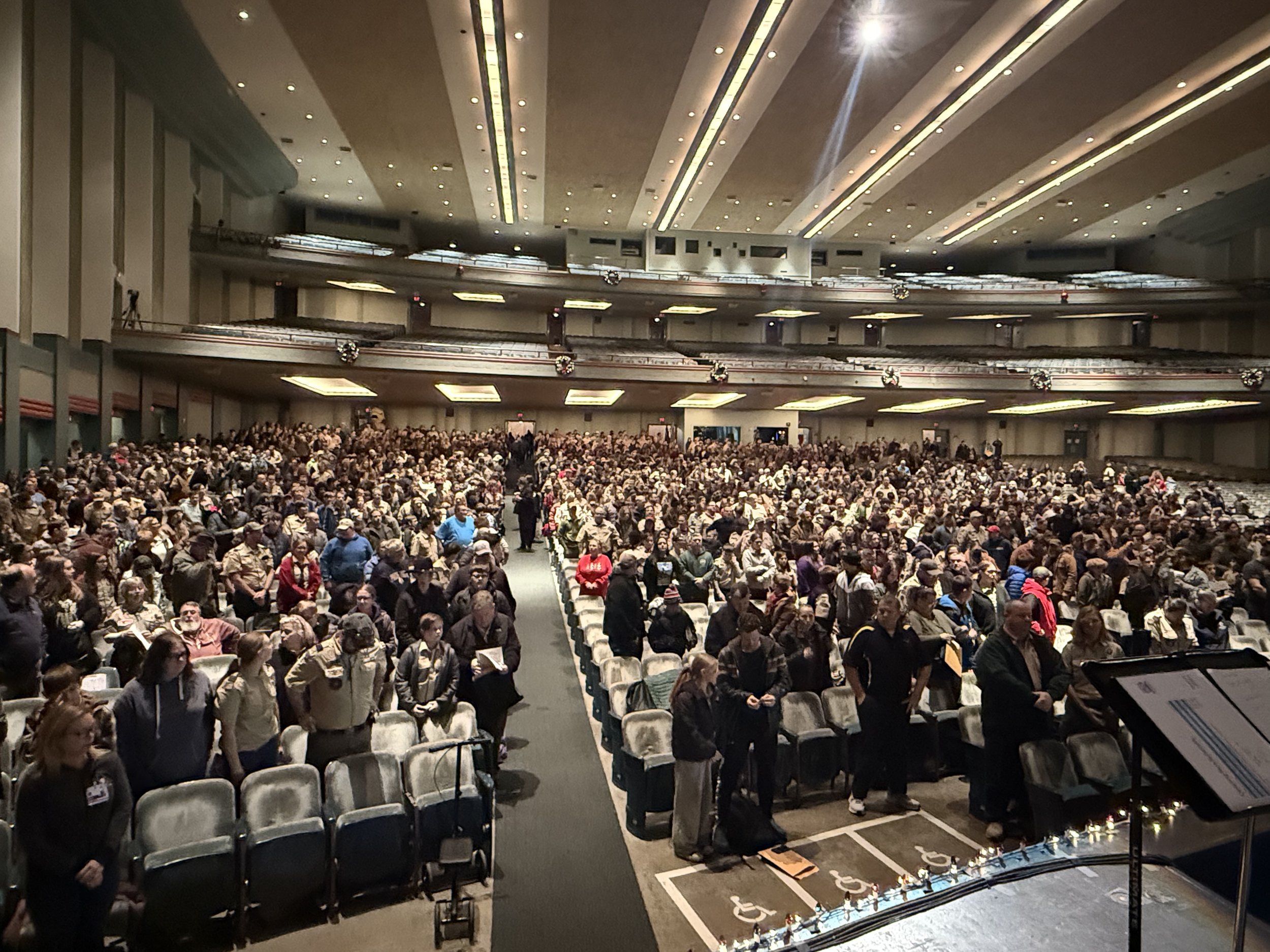
Scouts and Scout leaders from 26 states fill Purdue’s Elliott Hall of Music during the opening ceremony of the nation’s largest University of Scouting event on Dec. 6. More than 1,700 participants took part in the daylong program across campus.
WEST LAFAYETTE, Ind. — More than 1,700 Scouts and Scout leaders from 26 states gathered December 6 across Purdue University’s campus and the Greater Lafayette community for the nation’s largest “University of Scouting” event, delivered through a partnership between Scouting America’s Sagamore Council and Purdue’s Elmore Family School of Electrical and Computer Engineering, with financial support from IU Health and several additional sponsors.
The event transformed Purdue into a full day of hands-on learning, leadership training and STEM exploration. Youth participants engaged in more than 100 merit-badge courses spanning business, nature, STEM, hobbies, physical fitness, citizenship, personal development, aquatics and personal and community safety. With 116 merit badges offered, University of Scouting remains the largest merit-badge-based event of its kind in the country.
This year’s program showcased deep involvement from Purdue students, staff and faculty. Academic departments and campus groups hosted tables in the Purdue Armory vendor midway, while dozens of Purdue-led sessions took place in classrooms, labs and makerspaces in more than 30 campus buildings. Purdue volunteers helped lead merit-badge classes, STEM sessions, demonstrations and leader trainings, contributing to the efforts of the more than 300 volunteers who made the day possible.
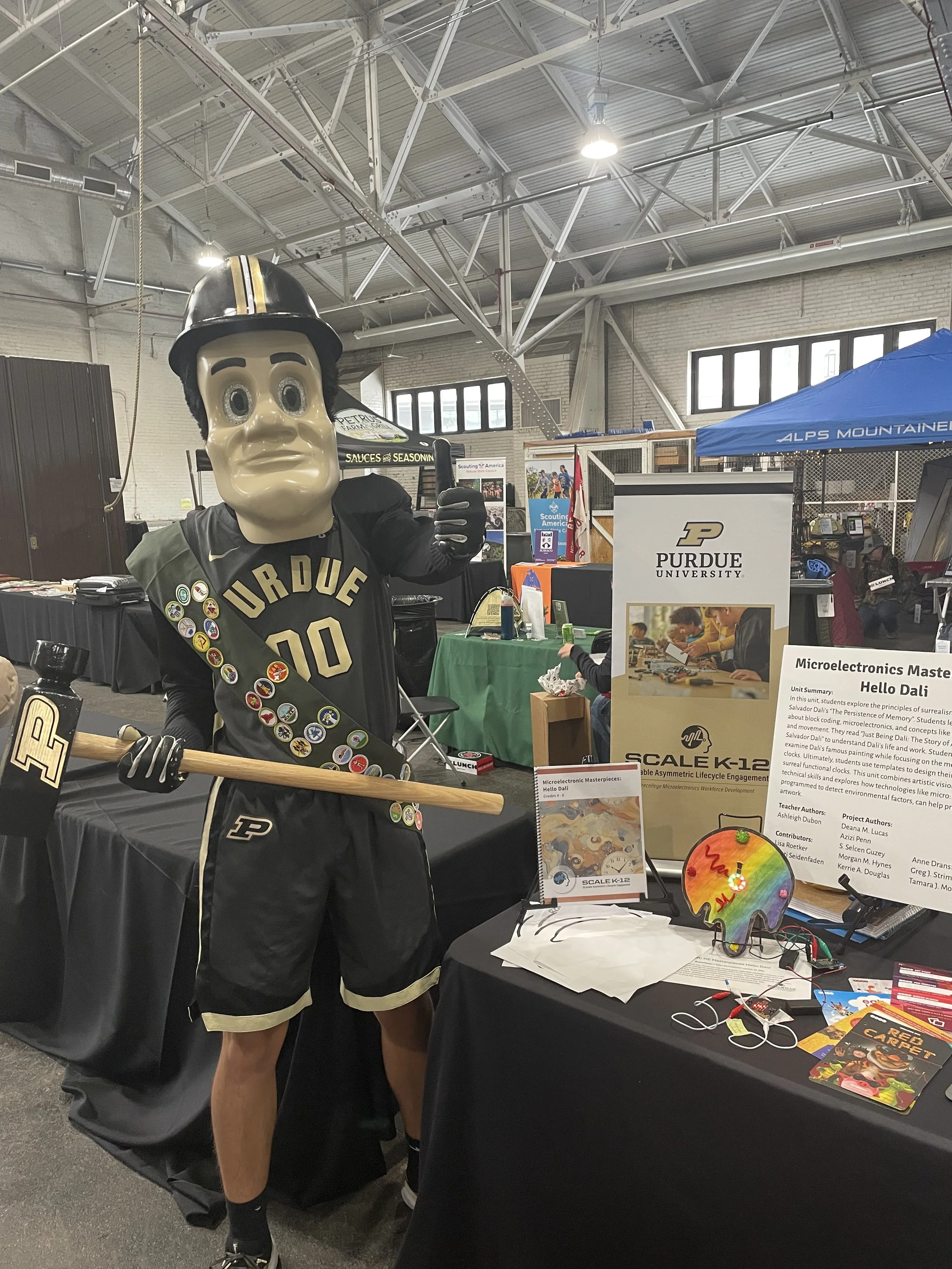
Purdue Pete gives a thumbs-up while visiting the SCALE K-12 table in the Purdue Armory during the University of Scouting event. SCALE K-12 staff and students supported the day with STEM activities, merit badge instruction, and leader training sessions.
“In Scouting, our mission is to prepare young people for their futures,” said Bryon Haverstick, Assistant Scout Executive and Chief Operating Officer for the Sagamore Council. “Partnering with Purdue University and the Elmore Family School of Electrical and Computer Engineering allows us to create life-changing educational opportunities for youth from across the nation. Whether Scouts choose STEM-focused badges like Engineering, Aviation, Digital Technology, and AI, or pursue Citizenship, Skilled Trades, or Aquatics, they learn directly from Purdue faculty, staff, students, industry professionals, and community leaders in high-quality, hands-on environments.”
Purdue’s SCALE K-12 program played a significant role in the day’s educational offerings. The team hosted an information table, led an Electronics Merit Badge class and facilitated a troop-leader workshop focused on integrating engineering habits of mind into youth programming. Their involvement provided Scouts and leaders with opportunities to engage directly with Purdue’s nationally recognized STEM-education initiatives.
“It was a great opportunity for SCALE K-12 to participate in this national scouting event and share information about microelectronics and the semiconductor industry,” said Dr. Greg Strimel, Associate Professor of Engineering/Technology Teacher Education. “Scouts and their leaders were highly engaged and eager to learn. Using the microelectronics instructional materials developed through SCALE K-12 to support the Electronics Merit Badge was especially meaningful. We were inspired by the Scouts’ capabilities and hope this experience not only introduced them to potential careers in semiconductors but also provided leaders with new ideas for future activities.”
Community partners also contributed essential hands-on opportunities. Nearly 30 classes were held off-campus with subject-matter experts teaching at their places of work, ranging from horsemanship at Wild About Horses in West Point, to dentistry at Klondike Dental Care, to Truck Transportation supported by Old Dominion Freight Line and Subaru of Indiana Automotive. The event also featured an Online Auction powered by Geswein Farm & Land Realty and Auction, which offered Scouts a fully immersive learning environment for completing the Auctioneering Merit Badge. Local indoor facilities supported aquatics merit badges that included scuba, lifesaving, kayaking and canoeing.
University of Scouting has grown dramatically, 375% since 2023 and 31% over last year, which itself was the largest event to date. The program is now the largest single-day youth event hosted at Purdue and generated the largest single-day order in the country from Jimmy John’s. Organizers credit the rapid expansion to strategic partnerships with Purdue, local businesses and regional industries, which together create meaningful, real-world learning experiences for Scouts.
In the spirit of the Scout Oath’s commitment to “help other people at all times,” the event also included a community toy drive benefiting Lafayette Urban Ministry’s Jubilee Christmas and a blood drive supporting the American Red Cross amid ongoing national shortages.
Scouts, leaders, Purdue partners and volunteers departed the event having strengthened skills, explored new interests, and connected with experts across fields, embodying both the mission of Scouting and Purdue’s land-grant commitment to educational access and community impact.
Purdue’s 2025 Engineering Gift Guide spotlights microelectronics with 10 standout STEM toys
WEST LAFAYETTE, Ind. — Purdue University has released its 12th annual Engineering Gift Guide, featuring 10 carefully selected toys and tools designed to spark curiosity and learning in microelectronics among children and teens.
Produced by the INSPIRE Research Institute for Pre-College Engineering, part of Purdue’s School of Engineering Education (ENE), the guide highlights gifts that blend play with purpose, introducing young learners to the foundational concepts of circuitry, robotics and programming.
This year’s guide continues to focus on microelectronics, a vital and cross-disciplinary field that powers everyday technologies like smartphones, computers and smart appliances. The selected gifts aim to help children understand how microelectronic systems work and how they are designed, coded and applied in real-world contexts.
“Microelectronics are everywhere, from the devices we use daily to the systems that drive innovation,” said Tamara Moore, professor of engineering education, co-director of INSPIRE and director of SCALE K-12, an ENE research program dedicated to embedding microelectronics learning into K-12 schools and curricula. “This year’s toys help kids connect the dots between coding and circuits and the engineering thinking behind the technology.”
Jennifer Heap, who oversees the Engineering Gift Guide, emphasized the importance of making engineering accessible and inspiring. “Each year, we aim to select gifts that not only entertain but also empower children to think like engineers,” Heap said. “This year’s focus on microelectronics reflects our commitment to helping kids understand the technology that shapes their world and inspiring them to imagine how they might shape its future.”
The INSPIRE Student Research Team, guided by faculty and staff, reviewed dozens of toys and kits, evaluating each for educational value, engagement and accessibility. The final list includes gifts that support hands-on learning, creativity and critical thinking. This variety ensures that families, educators and gift-givers can find options that align with their learners’ interests, skill levels and available resources. The full guide includes helpful details such as age ranges, estimated costs and skill level indicators to support informed and confident gift selection.
“This guide is the result of months of collaboration among students, faculty and staff,” Heap said. “It’s incredibly rewarding to see how these toys can open doors to engineering for kids and families everywhere.”
Each item was evaluated using INSPIRE’s research-based framework, which considers engineering design, STEM integration, computational thinking and accessibility. The full guide is available online and includes links to purchase and explore each gift.
Moore added, “We want kids to see themselves as engineers, problem-solvers, designers and creators. These toys help make that vision real.”
Purdue University awarded $1.99 million NSF grant to strengthen microelectronics integration within K-12 schools
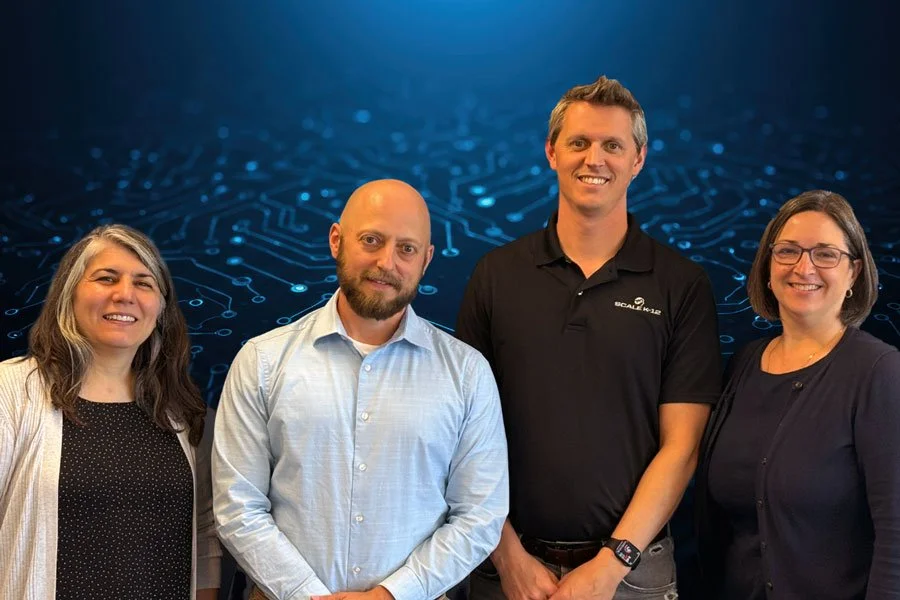
(Shown from left to right) S. Selcen Guzey, Greg Strimel, Morgan Hynes, and Tamara Moore with the Purdue University School of Engineering Education
A research team led by ENE's Greg Strimel along with Tamara Moore, Morgan Hynes, and S. Selcen Guzey are continuing SCALE K-12 efforts to bring advanced knowledge of microelectronics into classrooms and inspire the next generation of STEM professionals. Over the next five years, the team will recruit and prepare 15 practicing teachers as Microelectronics Master Teacher Fellows to serve high-need districts.
Purdue University has received a $1.99M grant from the National Science Foundation (NSF) to prepare K–12 teacher leaders who can bring advanced knowledge of microelectronics into classrooms and inspire the next generation of STEM professionals.
The five-year project, a “Microelectronics Master Teacher Fellowship Program,” will run from October 2025 through September 2030 as part of NSF’s Robert Noyce Teacher Scholarship Program. During that period of time, Purdue will recruit and prepare 15 practicing teachers as Microelectronics Master Teacher Fellows to serve high-need districts and integrate microelectronics-focused STEM curricula.
Leading the project is Greg Strimel, Purdue Polytechnic Institute’s interim department head and associate professor of technology leadership and innovation, with co-principal investigators Tamara Moore, professor of engineering education; Morgan Hynes, associate professor of engineering education; and S. Selcen Guzey, associate professor of science education in the Departments of Curriculum and Instruction and of Biological Sciences. All are faculty in the Purdue School of Engineering Education (ENE) with Strimel and Guzey holding courtesy appointments.
The initiative addresses the national demand for a workforce ready to advance U.S. competitiveness and security in microelectronics. Fellows will gain expertise through microelectronics experiences, graduate coursework, and annual teacher summits, while leading district-wide alignment efforts for microelectronics education. The project partners with Regional Opportunity Initiatives, Naval Surface Warfare Center–Crane, and the Silicon Crossroads Microelectronics Commons Hub, serving districts that include Washington Community Schools, Lafayette School Corporation, Loogootee Community Schools, and Purdue Polytechnic High Schools.
“This award provides an opportunity for Purdue to build national leadership in preparing teachers who can connect microelectronics research with K–12 education,” said Strimel. “The Master Teacher Fellows program not only will expand teacher expertise but strengthen pathways for students into critical technology fields.”
The project builds on Moore’s leadership in SCALE K-12, a program within the Scalable Asymmetric Lifecycle Engagement (SCALE) microelectronics workforce development initiative. The SCALE K-12 program develops curriculum and professional learning experiences to help teachers introduce semiconductor and microelectronics concepts to students. Lessons from this program will inform the fellowship’s curriculum design and outreach, strengthening pathways from K–12 classrooms into the microelectronics workforce.
“By equipping teachers with cutting-edge knowledge in microelectronics, we are not only giving them the tools to spark student curiosity but also empowering them to prepare young people for careers that directly shape our nation’s future,” Moore said. “Our goal is to make microelectronics accessible in every classroom, connect learning to real-world opportunities, and inspire a diverse generation of innovators who will drive the next wave of technological breakthroughs.”
Supported in part by Micron Technology, Inc., the project will also contribute research on effective strategies for teacher leadership and retention in high-need districts, with results shared through national conferences, microelectronics hubs, and open-access resources.
Purdue SCALE K-12 program partners with Arm in EducateAI Coalition
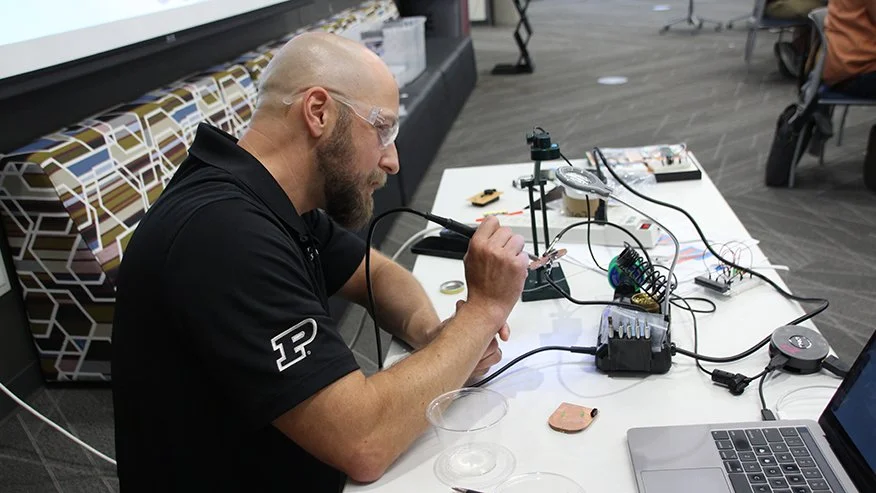
Greg Strimel, interim head of Purdue Polytechnic’s Department of Technology Leadership and Innovation and an associate professor, demonstrates soldering microelectronics parts to a circuit board to teachers at a SCALE K-12 summer workshop at Purdue University. SCALE and SCALE K-12 programs are part of a new partnership to launch the Arm EducateAI Coalition.
WEST LAFAYETTE, Ind. — Purdue University’s Scalable Asymmetric Lifecycle Engagement and SCALE K-12 programs will continue to prepare America’s youth for careers in emerging technologies thanks to a new partnership with high-performing compute platform Arm to launch the Arm EducateAI Coalition.
SCALE, led by Purdue, partners with universities, government and industry to prepare a highly skilled microelectronics workforce. The SCALE K-12 national initiative equips teachers and schools with the tools to design and implement engaging learning experiences in microelectronics.
“With SCALE and SCALE K-12 serving as the primary partners with Arm in this coalition, we are proud to help lead the Arm Education initiative within the EducateAI Coalition,” said Tamara Moore, a professor of engineering education, program director for SCALE K-12 and curriculum director for SCALE. “This critical effort ensures that young people are equipped with the knowledge and skills to engage meaningfully in the future workforce both as informed users and, for many, as emerging developers of AI technologies.”
This week at the White House, more than 100 organizations met to support the Pledge to America’s Youth: Investing in AI Education. The launch of the Arm EducateAI Coalition, a nationwide initiative focused on advancing AI literacy and providing students and educators with the knowledge and tools needed to succeed, was announced Thursday.
“This exciting partnership with Arm exemplifies Purdue’s strategy to maximize impact through intentional partnerships with industry,” said Dan DeLaurentis, Purdue’s executive vice president for research. “Further, this effort will activate the broader Purdue asset base including efforts from our Institute for Physical AI and broader Purdue Computes strategic programs.”
Purdue’s national leadership in microelectronics and semiconductors is a cornerstone of Purdue Computes — a comprehensive initiative that spans computing departments, physical artificial intelligence, quantum science and semiconductor innovation.
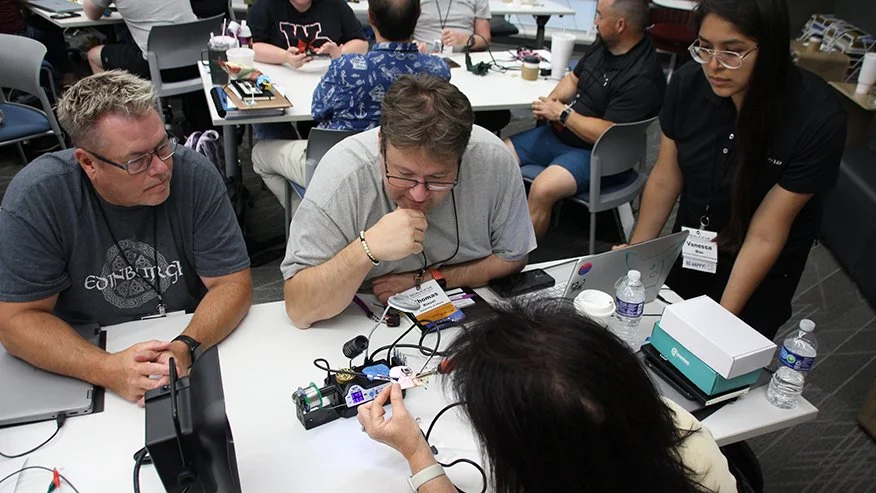
During a summer workshop at Purdue, SCALE K-12 teacher fellows explore microelectronics, learn new soldering techniques and collaborate on writing curriculum units to bring back to their classrooms.
A national commitment to AI education
As part of the White House AI pledge, SCALE and SCALE K-12 — flagship workforce and science, technology, engineering and math education initiatives of the U.S. Department of Defense led by Purdue University — are contributing their expertise in microelectronics and advanced technology education. SCALE K-12 is taking a leading role in this effort through its national educator networks and curriculum design, while SCALE is using its network of community colleges and universities to expand the work in higher education. Both are working closely with Arm to expand access to AI learning. Arm is a critical driver of the AI revolution, providing the foundational compute platform that enables developers and partners to create and deploy intelligent, efficient and secure AI solutions at a global scale.
“By partnering, we are ensuring that U.S. students not only gain opportunities in the emerging semiconductor workforce but are also prepared for the broader future of work where AI will play a central role,” said Kerrie Douglas, an associate professor of engineering education and co-director of SCALE. “This collaboration enables SCALE and SCALE K-12 to address the immediate workforce needs of the nation while also laying the foundation for jobs that do not yet exist but will depend on AI literacy.”
By combining Arm’s global leadership in computing and AI education with SCALE K-12’s strengths in educator preparation and curriculum development, the coalition will create stronger pathways from classroom to career by bridging K-12 schools with SCALE universities and training programs.
What the coalition will deliver
Over the next four years, the coalition will provide:
More than 500 workshops and training events delivered across the country
20 regional programs bringing AI tools into classrooms, reaching millions of students
40,000 teachers trained and certified, supported with classroom-ready curricula and credentials
Engagement with more than 5,000 educational institutions, broadening access to AI learning nationwide
Building AI literacy across the learning journey
The coalition will provide a structured progression of AI knowledge and aptitude, equipping students with age-appropriate knowledge and hands-on skills at each stage of learning:
Grades K-5: Core concepts, computational thinking and project-based learning
Grades 6-8: Introduction to machine learning, data science and natural language processing
Grades 9-12: Advanced coursework on AI models and their applications
Higher education and workforce: Microcredentials and certifications through colleges and universities
Preparing educators
Teachers play a pivotal role in the success of this initiative. With support from SCALE K-12, the Arm EducateAI Coalition delivers essential resources and guidance to drive meaningful impact in classrooms nationwide through:
Training and resources to integrate AI concepts into classrooms
Classroom kits and curricula designed for practical AI applications
Certification programs to expand AI teaching capacity nationally
Leadership development opportunities to support sustainable AI education programs
Participating Purdue units include the School of Engineering Education, the Elmore Family School of Electrical and Computer Engineering, Purdue Polytechnic’s Department of Technology Leadership and Innovation, and the College of Education’s Department of Curriculum and Instruction.