
Kids Love Chips: Nurturing a Domestic Technology Workforce
By: John Martin
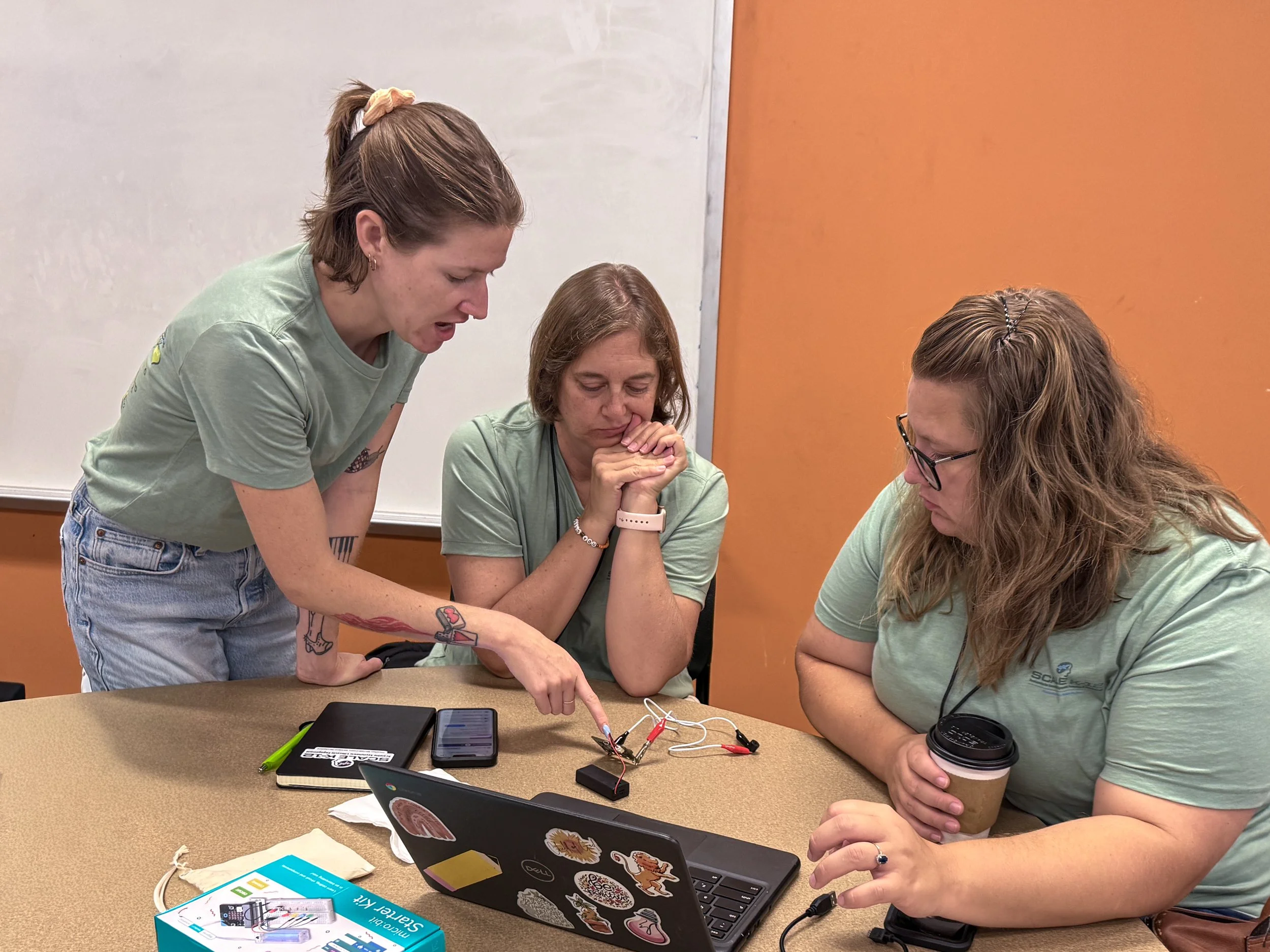
Kids love chips, and not just the edible kind — rather, semiconductor chips, and it turns out kids really love them. When given the opportunity at an early age to learn about them — what they’re made of, how to make them, how to use them — kids embrace them just as they once did physical building blocks — although this time they are learning about and constructing with the building blocks that are at the heart of everything in our technology age.
This technology stimulation is not only great for exciting and motivating young minds — it’s a way to better prepare them for high-paying career opportunities in the field. This is not only vital for a growing economy and individual economic security — it’s critical for national security, where dependence on foreign suppliers creates intolerable supply chain risks.
SCALE K-12 aims to expose, motivate, and ultimately prepare students from various backgrounds with the skillset and mindset for careers in defense-related microelectronics. It helps school districts integrate microelectronics across all levels and content areas of K-12 education. This includes partnering with teachers from these districts to design curricular modules and activities for microelectronics.
SCALE K-12 stands for Semiconductor Connections, Alignment, Learning, & Engagement in K-12. Led by Purdue University, the program brings together educators and university partners to introduce K-12 students to microelectronics and build pathways toward future careers in the field. SCALE K-12 is related to the SCALE program, a Purdue-led network of collaborators who address the urgency of microelectronics workforce development. The overall SCALE program targets higher education students in a 35-university network and is the preeminent U.S. program for semiconductor workforce development in the defense sector.
Led by the School of Engineering Education’s professors Tamara Moore and Morgan Hynes, as well as professors by courtesy, Selcen Guzey (Curriculum and Instruction) and Greg Strimel (Engineering Technology), SCALE K-12 targets school systems, educators, and students from kindergarten through 12th grade, partnering with Indiana University, University of Illinois, University of Detroit Mercy, and a number of regional collaborators.
Meeting a pressing need
Microelectronics are vital to almost every aspect of modern life and foundational to U.S. national defense and security. The United States is facing a large and widening gap between its domestic needs and its microelectronics design and manufacturing capabilities, resulting in a growing dependence on foreign suppliers.
It is crucial to bring students into this area much earlier to maximize the chances that they consider these high-paying career opportunities in their region. The challenge is to rapidly increase K-12 awareness of and interest in prioritized microelectronics areas in a scalable way.
“If we wait until college to attract students to the microelectronics fields, it is too late,” says SCALE K-12 director, Tamara Moore, the Crowley Family Professor in the School of Engineering Education. “By providing students in K-12 with immersive experiences with engineering infused with microelectronics in contexts that are meaningful to them, we can broaden the range of students who see themselves pursuing careers in the microelectronics industry.”
SCALE K-12 partners with teachers to develop and implement curricular modules and activities focused on microelectronics contexts and concepts. Middle-school geometry teachers, for example, may use the idea of how to manufacture microchips to teach the concepts of area and volume. The SCALE K-12 team also conducts research to assess the impact of using engineering design as a pedagogical tool to integrate microelectronics into the curriculum; teachers receive funding for participation and the classroom materials needed to implement curricular units.
Introducing Microelectronics Early
SCALE K-12 exposes students to the microelectronics field and its intersection with national defense and the defense industrial base. SCALE K-12 curriculum workshop topics and activities have included learning about microelectronics hardware, applications, and careers; understanding engineering and engineering design and its relevance to microelectronics; participation in exploration fairs; touring Purdue’s Birck Nanotechnology Center; engaging SCALE K-12 camp students via a Gallery Walk of their engineering projects; and developing microelectronics-related, engineering-design-based STEM integration curriculum units.
The development of curricular units that integrate microelectronics is a collaborative work product designed by SCALE K-12 teams of Teacher Fellows (practicing teachers), STEM Education faculty and staff, and graduate research assistants.
As part of SCALE K-12 teacher outreach efforts, Teacher Fellows from each school district are selected and participate in a week-long summer curriculum development workshop where they explore different aspects of the field, such as microelectronics manufacturing and supply chain processes, nanomaterials, industry-sector employers and product applications, hands-on experimentation labs, and U.S. national interests.
Participating SCALE K-12 districts engage in what is called Vertical Alignment. This includes mapping developed microelectronics units with the district’s current STEM, career awareness and employability skills initiatives. The teaching plans will describe student learning and activities in the areas of career awareness, employability skills, and technical skills related to microelectronics across K-12, linking concepts and experiences from grade to grade.
Making Mathematics Matter
Let the Chips Fall Where They May, for example, is an integrated STEM curriculum for middle and high school students that gives students a glimpse of what it is like to solve a real semiconductor manufacturing problem. Students become engineers working for the fictional Geti Games, where a popular gaming controller has created an urgent need for more microchips. Their client, CEO Skylar Geti, presents the problem, but not all of the information students need comes at once. As the challenge unfolds, students ask questions, communicate with their client, respond to new information and requirements, and refine their ideas — much as engineers do in professional practice.
To help Geti Games, students investigate how silicon becomes wafers and how individual chips are arranged and cut from those wafers. In a unit aligned with Common Core mathematics standards, they use geometry and mathematical modeling to calculate material use, chip yield and waste, then look for ways to make the manufacturing process more efficient. A resource-trading game adds another layer to the problem, helping students see that producing microelectronics depends not only on engineering, but also on the availability, cost and global distribution of materials such as silicon, copper and cobalt. Students ultimately design improved wafer layouts, weigh competing considerations and present an evidence-based recommendation back to their client. Along the way, mathematics that may have seemed abstract becomes a tool for solving a problem tied directly to the technologies students use every day. The unit also introduces students to careers such as semiconductor manufacturing engineers, process engineers, materials engineers and electrical engineers.
Literature, water… and microelectronics?
Another set of curricular units is created through Novel Engineering, a curricular innovation led by Morgan Hynes, associate professor in Purdue University’s School of Engineering Education. Targeted at grades K-8, Novel Engineering uses classroom literature as the context for engineering challenges. As students read a story, they identify problems faced by the characters and begin thinking like engineers about how those problems could be solved. Students determine who their client is in the story, define the problem that the character is experiencing, and then design creative solutions using the engineering design process.
“A good book can really motivate the engineering problem solving process by providing rich contexts for students to engage with,” says Dr. Morgan Hynes, associate professor in Purdue University’s School of Engineering Education and director of the INSPIRE Research Institute for Pre-College Engineering. “We've seen so many students get personally invested in the characters and details of the story as they try and come up with solutions. Adding microelectronics in the mix allows students to develop sophisticated solutions that can react and respond to the user or the world. Meaningful problems with technical solutions can go a long way in having students experience what engineering is all about.”
In SCALE K-12’s adaptation, students incorporate microelectronics into their solutions, using components such as sensors, LEDs, or microcontrollers to address a character’s problem. This connects engineering design to the electronic technologies students encounter in everyday life.
Through this approach, students strengthen both their literacy and STEM skills. They practice reading closely, thinking critically, collaborating with peers, and designing solutions that bring the story to life through hands-on innovation. By combining storytelling with engineering design, Novel Engineering helps students see literature in a new way and teaches them through experience how to become creative problem solvers.
A third example — Water, Water Everywhere — is a middle school science unit focused on learning about water resources and water quality. This unit covers standards about Earth’s systems, human activity, and engineering design. Students explore the water cycle, human impact on the environment, water treatment, data analysis, and evidence-based reasoning.
“When students are given the opportunity to utilize technology to investigate a problem that matters to people, they begin to see themselves not just as learners of science and engineering, but as agents of change who can use those fields to make a difference,” says Dr. Rachel E. Higbee, a postdoctoral researcher with SCALE K-12 at Purdue University. “That is exactly what we wanted students to experience through this unit.”
The engineering design challenge asks students to develop an efficient, simple-to-use microelectronic water quality testing device for communities that lack access to safe drinking water. Students code a micro:bit to measure water quality parameters and use the data to make evidence-based design decisions. These activities align with state educational standards. The unit also introduces careers related to water treatment and semiconductor manufacturing, including ultrapure systems engineers, chemists, process engineers, and semiconductor manufacturing engineers.
Preparing our children for the future
Funding for SCALE K-12 reflects recognition of both a regional and national need: it’s provided by the U.S. Department of Defense, the Indiana Economic Development Corporation, the Applied Research Institute, the Silicon Crossroads Microelectronics Commons Hub, and the National Science Foundation.
Through its work with young minds, SCALE K-12’s mission is to connect early classroom experiences to the broader need for a domestic semiconductor workforce. Teachers integrate microelectronics into subjects they already teach, helping students discover connections to everyday technology and career possibilities. “SCALE K-12 gives students an opportunity to recognize that the world we live in is filled with microelectronics and can spark a lifelong interest in some that may not be accessible to them without this program,” Moore says.
Those possibilities are substantial. Reporting cautions that the U.S. semiconductor industry faces a potential shortfall of some 157,000 skilled workforce personnel by 2030. It’s estimated that at least 50,000 of that total should be trained semiconductor engineers.
SCALE K-12’s work spans Indiana, Illinois, and Michigan and has reached more than 38,000 students, introducing young people to the field and the opportunities it offers. Some 200 teachers have already been trained to deliver microelectronics instruction. Sixty-five schools are currently expanding microelectronics pathways, using some 100 curriculum units and lessons.
Children love technology, and SCALE K-12 introduces them to it at a formative stage, brightening their futures while strengthening American technological primacy and national security.