
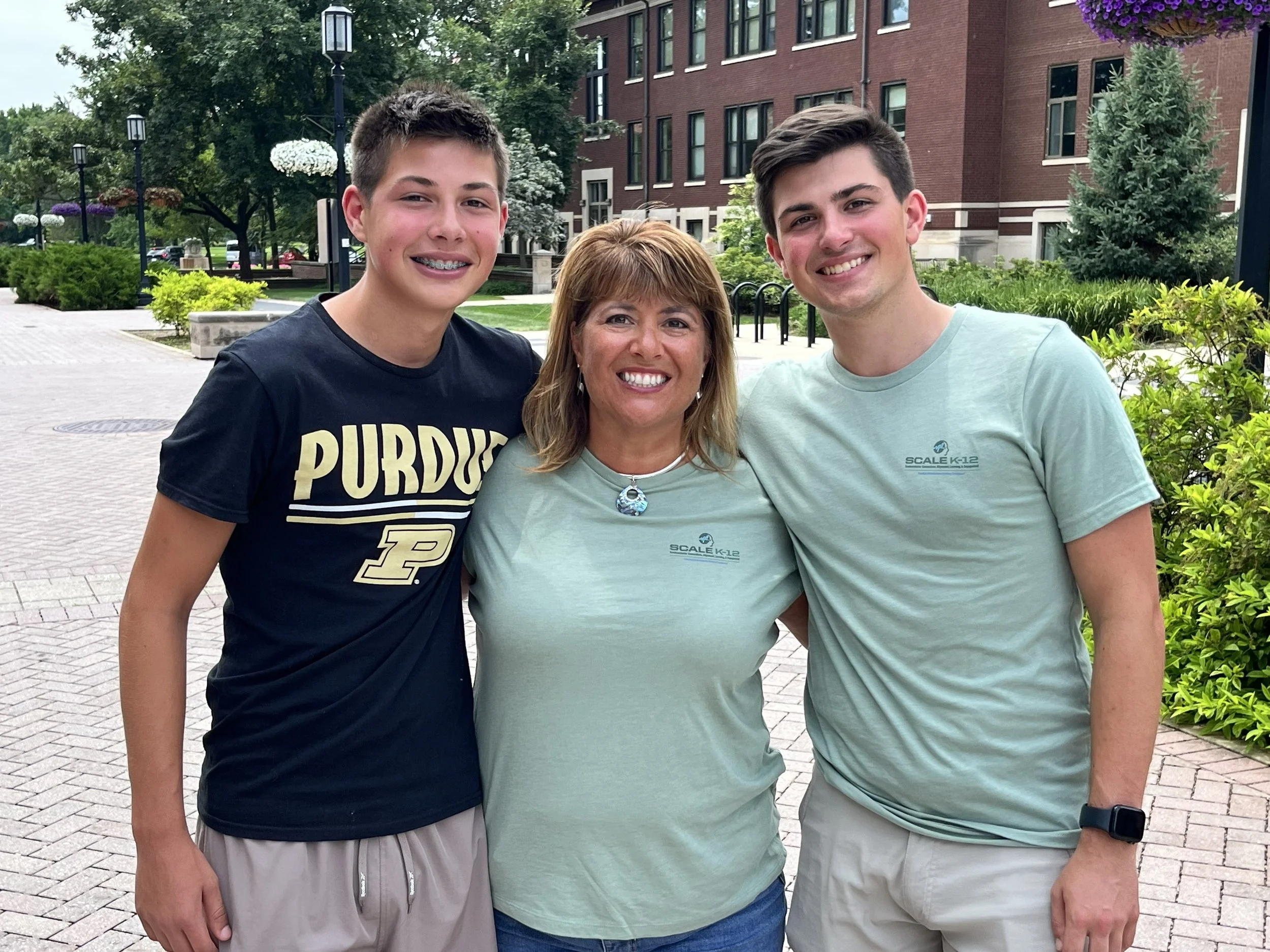
Melanie Gilbert (center) with her sons, Matthew (left) and Andrew (right).
Indiana high school teacher Melanie Gilbert didn’t realize she was igniting a family passion when she became involved with SCALE K-12 four years ago. She just wanted to expose her students to microelectronics education and career awareness, often an unfamiliar technology and job path for many younger students.
SCALE K-12 stands for Semiconductor Connections, Alignment, Learning, & Engagement in K-12. Led by Purdue University, the program brings together educators and university partners to introduce K-12 students to microelectronics and build pathways toward future careers.
Through SCALE, Gilbert not only capitalized on her young students’ fascination with technology — her oldest son Andrew began participating in the program, and is now entering Purdue, where he plans to study engineering. Andrew’s younger brother Matthew joined the family cavalcade and has taken part in the SCALE program since middle school; he hopes to pursue engineering, and work with younger students in the program to fan their interests.
What’s particularly noteworthy is that engineering was initially not older sibling Andrew’s end goal. But through his opportunities to engage with engineering and microelectronics, work alongside researchers, and help teach younger students, it became the path he wanted.
And he’s already giving back: teaching is a big part of what he now likes, he sees what a big difference it can make. “Getting that knowledge so early is helpful,” he said. “I feel that if I had had it earlier, I would have had a different path into engineering. I feel really lucky that I am able to help younger students so early and get them started on their path toward engineering.”
Younger brother Matthew is testament to the value of that earlier start.
“I'm going to be a high school sophomore this year,” he said. “I got involved in these programs through my mom and my brother. Their involvement in SCALE showed their interest and how much they liked it, so I wanted to see what it was like. It really became an interest of mine, and I've liked learning about microelectronics and everything related with SCALE.”
“If we wait until college to attract students to the microelectronics fields, it is too late, ” says SCALE K-12 director Tamara Moore, the Crowley Family Professor in the School of Engineering Education. “By providing students in K-12 with immersive experiences with engineering infused with microelectronics in contexts that are meaningful to them, we can broaden the range of students who see themselves pursuing careers in the microelectronics industry.”
Meet the Gilbert Family
Hear Melanie, Andrew, and Matthew share how their experiences with SCALE K–12 helped shape their interests, create new opportunities, and inspire them to introduce engineering to younger students.
Teaching Foundational Technology to Our Foundation: Our Children
Microelectronics are vital to almost every aspect of modern life and foundational to U.S. national defense and security. The United States is facing a large and widening gap between its domestic needs and its microelectronics design and manufacturing capabilities, resulting in a growing dependence on foreign suppliers. Reporting cautions that the U.S. semiconductor industry faces a potential shortfall of some 157,000 skilled workforce personnel by 2030. It’s estimated that at least 50,000 of that total should be trained semiconductor engineers.
SCALE K-12 is tackling that workforce challenge years before college by bringing microelectronics education awareness into K-12 classrooms. It has already reached more than 38,000 students, trained close to 200 teachers, and works with 73 schools across three states.
Melanie Gilbert, who teaches at Lafayette Jefferson High School, is at the forefront of that early exposure effort, bringing both a teacher’s and a parent’s perspective to the job. She is one of the bright lights of the program, and has been honored for her work by being appointed a SCALE Noyce Master Teacher Fellow. These fellows are paid extra to be a leader in their district and can get a Masters degree for free as part of the program.
Teacher Fellows from each school district are selected and participate in a week-long summer curriculum development workshop where they explore different aspects of the field, such as microelectronics manufacturing and supply chain processes, nanomaterials, industry-sector employers and product applications, hands-on experimentation labs, and U.S. national interests.
The overall SCALE K-12 curriculum workshop for educators includes learning about microelectronics hardware, applications, and careers; understanding engineering and engineering design and its relevance to microelectronics; and developing microelectronics-related, engineering-design-based STEM integration curriculum units.
Getting children excited
Melanie’s kids attest to the results. “In seventh grade, I was in one of the INSPIRE camps, and we did a lot with micro:bits,” says Matthew. “I made a lot of new friends, and there were a couple of people I already knew, so it was easy to talk to people. It was a really good program, and it taught me about microelectronics.”
Older brother Andrew, currently a freshman at Purdue, recollects his program involvements. “I first got involved with the PITCH program two years ago, and later that summer, I got involved with the MicroArtistry program,” he says. “The summer after that, I got in touch with Dr. Morgan Hynes, one of the SCALE K-12 directors. He hired me, and I helped facilitate and run both PITCH and MicroArtistry. In addition, I helped facilitate research for the INSPIRE camps. In the past two summers working for Dr. Hynes, I was able to teach and facilitate research for the INSPIRE camps, which serve students from first grade through ninth grade.”
Andrew and Matthew are referring to some of the core programs in SCALE K-12. PITCH (Purdue Ivy Tech CHips) is a 10-day summer experience for rising high school juniors and seniors from the Greater Lafayette region designed to build a talent pipeline for the regional semiconductor microelectronics industry. Purdue INSPIRE conducts middle school summer camps focused on coding, robotics, and circuitry. MicroArtistry is a summer residential program for rising high school juniors and seniors that merges art, engineering, microelectronics, and social impact, exploring how technologies like AI semiconductors shape society, ethics, and daily life.
Matching Workforce Development to Factory Construction
As the U.S. invests billions in rebuilding its semiconductor industry, the country faces a challenge that goes beyond building new facilities: developing the people needed to design, manufacture and support the technology.
That challenge is particularly visible here in West Lafayette, Indiana, where Purdue recently broke ground with SK hynix on a more than $4 billion advanced packaging and R&D facility — in the same community where this microelectronics K-12 workforce pipeline is being developed.
SCALE K-12 approaches the workforce challenge from much further upstream, introducing students to microelectronics, engineering and related careers throughout their K-12 education, rather than waiting until they reach college to ask them to choose a STEM career. (SCALE K-12 is related to the SCALE program, which targets the higher education students.).
The proof is in the pudding — what it means to the children. Melanie Gilbert has a distinctly personal view, from her vantage point as both instructor and mom to the program’s students.
“When it's your students, you're excited for them,” she says. “You want them to have success and move forward in positive ways. You're their cheerleader, and want to see great things for them. But when it's your own children, it's even more meaningful. For me to be able to get my own kids involved in all of these programs has been an amazing opportunity for our family. From when my youngest was maybe ten, the first time he went to an INSPIRE camp, through now at the college level, they've had ways to gain assistance and knowledge, and develop through the different SCALE programs at each step along the way.”
She sees a bright future ahead — something every parent can appreciate.
“I only see SCALE K-12 going in a positive direction moving forward because it's providing different opportunities and resources so the children have an understanding of what's out there, along with networking opportunities,” Gilbert said. “We've seen amazing growth in them personally and professionally — both my sons and the other children — through the different experiences they've had.”